
Technologies Emulsifiers
Innovative Emusifier Chemistries
Our specialty emulsifiers allow oil and water phases to remain stable inside demanding industrial systems. At Nelson Brothers Specialty Chemicals, emulsifier chemistry sits at the center of our work across multiple markets. For more than three decades, we have developed and refined emulsifiers for complex formulations, beginning in the explosives sector and expanding into other industrial environments that require consistent phase control, stability, and predictable performance. As an experienced emulsifier manufacturer, we focus on the chemistry behind emulsification.

How Emulsifiers Work
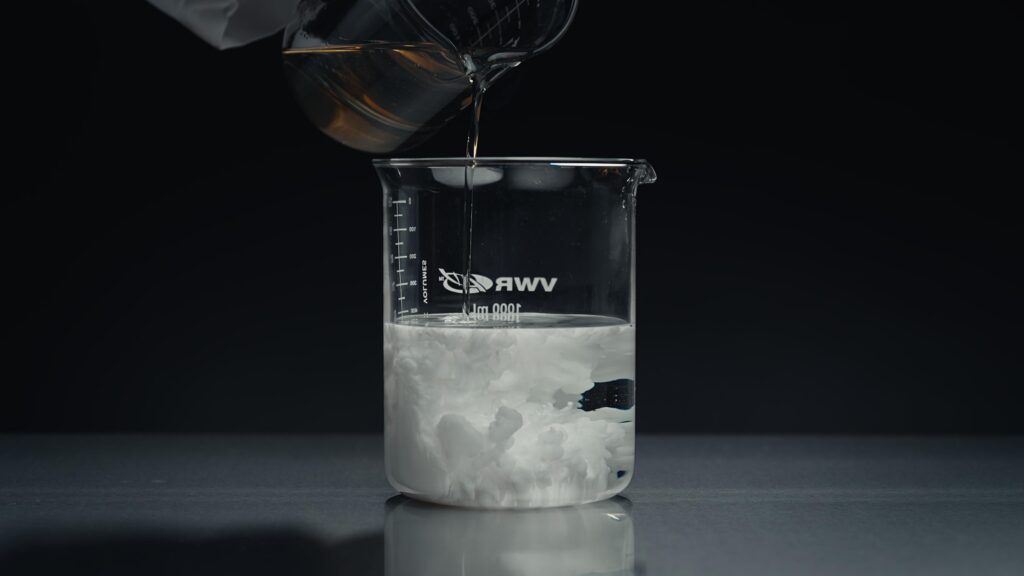
Emulsifiers allow oil and water to remain evenly distributed by lowering the tension at their interface. Each surfactant molecule aligns itself between the two phases, anchoring one end in water and the other in oil. This structure keeps droplets from separating during storage and circulation. As an emulsifier company with extensive formulation experience, we apply this chemistry in systems that operate under pressure, temperature shifts, and continuous mechanical load.
Well-designed emulsifiers provide consistent oil solubility and stable dispersion under operating conditions. Many systems benefit from controlled foaming behavior, predictable droplet size, and steady performance during mixing and circulation. As an experienced emulsifier supplier, we design formulations that maintain stability across production cycles rather than short-term laboratory conditions.
What Are Common Emulsifiers?
We develop specialty emulsifiers using several well-established surfactant types, selecting each based on how the phases behave and how the system operates.
Nonionic Surfactants
Nonionic surfactants maintain emulsion stability across a broad temperature range and handle shifts in water chemistry without issue. These materials suit systems that need controlled emulsification without reliance on ionic interaction.
Polymeric Surfactants and Dispersants
Polymeric surfactants and dispersants stabilize emulsions through physical spacing rather than electrical charge. This structure helps control droplet size and maintain dispersion under shear, which supports performance in demanding industrial environments
Anionic Surfactants
Anionic surfactants use charge repulsion to keep droplets separated. These materials perform well in systems where water chemistry supports stable electrostatic behavior and consistent dispersion.
Cationic Surfactants
Cationic surfactants bond readily to negatively charged surfaces and phases. They fit applications that require focused surface interaction rather than broad emulsion stability.
Why Choose Nelson Brothers Specialty Chemicals for Emulsifiers
Nelson Brothers Specialty Chemicals brings long-standing experience in surfactant chemistry and emulsion design. We approach emulsifier development with a focus on chemistry, process conditions, and system behavior. As a trusted emulsifier manufacturer, we help customers apply proven emulsifier chemistry across complex industrial environments where stability and consistency matter. Our emulsifier technologies serve a range of industrial markets, including emulsifiers for bulk explosives and packaged emulsion explosives, emulsifiers for metalworking fluids, and emulsifiers for water science applications such as inverse emulsion polymer systems.

Apply Proven Emulsifier Chemistry Across Demanding Formulations
Reach out to our team to discuss emulsifier chemistry that fits your process conditions and performance goals. We help customers apply proven surfactant systems that maintain stability across challenging industrial environments.